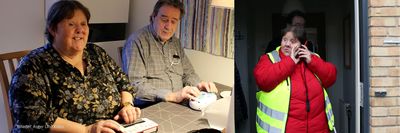
Thanks to a range of assistive products and technological solutions, Jeannette Hjortlund Voer and Svend Pedersen lead a more independent, free and self-reliant life.
By Asger Lind Krebs
The first thing that strikes you when you step into Svend Pedersen and Jeannette Hjortlund Voer's terraced house in Espergaerde is how tidy it is. Nothing is lying on the floor. There are no items left out on the kitchen counter. Everything is neatly stored in drawers and cabinets.
"It's always tidy here. And there are systems for everything. That's important. Otherwise, we'd be running around searching for things forever."
— Jeannette
Both she and Svend are blind. Svend has been completely blind since birth, while Jeannette could see shadows and colours until she was 7 years old.
A major difference
Although both are totally blind, Svend and Jeannette lead active and social lives with work, family, friends and leisure activities. They can thank a range of assistive products and technological solutions for that.
"It is the foundation for us being able to manage on our own for the most part. We are more self-reliant in a number of areas and have less need for home care workers coming by all the time."
Jeannette and Svend appreciate being able to handle as much as possible themselves. The digitisation of communication with public authorities has meant they no longer have to share their personal information with others — they can read their own mail, respond to messages and so on.
"Our neighbours don't actually notice that we're blind. It hasn't always been that way. We used to have to ask neighbours for help with things like reading mail that could contain deeply personal information."
— Svend
"Assistive products and technological solutions give us freedom, independence and self-reliance. We can do what we want, when we want."
— Jeannette
Technological possibilities
Many of the assistive products that help Svend and Jeannette in their daily lives are on their phones. They use Seeing AI, among other things — a kind of talking camera that uses the phone's camera to read what is written on packaging, describe images, and tell them whether they've remembered to turn the lights on or off.
Be My Eyes is a Danish-developed app. A team of volunteers is connected to the app. If Svend or Jeannette find themselves in a situation where they need a pair of seeing eyes, the app connects them with a volunteer who can help.
"When I was young, I could do almost nothing without help. There has been a massive improvement with the digital revolution."
— Svend
Braille in everyday life
Although phones with specialised apps can solve a lot, there are still situations where Braille is more practical. Svend prefers to read books in Braille. Jeannette uses it during meetings and home visits as part of her job.
In the kitchen, they have labels with Braille on food items, a talking kitchen scale, a talking tape measure and a knife that can be set to cut slices of a specific thickness.
Experiencing limitations
Despite the assistive products, both experience limitations. Two years ago, Svend was hit by a car — an acoustic traffic signal indicated green, but shortly after he was struck hard by a vehicle. He suffered a skull fracture, brain injury, a broken nose and a broken leg.
"Since then, I've become incredibly afraid of walking in traffic, so now I only take certain routes where there are no cars."
— Svend
"But there is no doubt that our disability has become less intrusive in our lives thanks to the various assistive products and digital solutions that have emerged."
— Svend
Visit the Vision Area at the fair in C2-050 and learn more about assistive products for living with visual impairment.