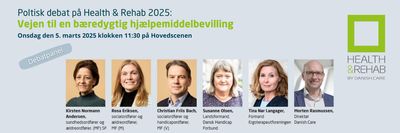
How do we create a structure for the provision of assistive products that is sustainable — in human, professional and economic terms? That is the theme of the Health & Rehab political debate.
By Asger Lind Krebs
More than 300,000 Danes rely on assistive products. Some need only a pair of crutches, while others depend on a range of devices to live as freely and independently as possible.
The path to obtaining the right assistive products is often difficult and time-consuming. Many end up being bounced between regions and municipalities, which also leads to a waste of public resources.
There are numerous examples of how people's chances of being granted assistive products vary from one municipality to another. We also hear that professional expertise lacks the right framework. As a result, important information about citizens' unique circumstances is lost, and the preventive perspective fades into the background.
Most people agree that the current system for assistive product provision in Denmark is unsustainable — in human, professional and economic terms — and that the structural framework needs to change.
Harder Access
At Health & Rehab, we have assembled a strong panel for a political debate on how to create a sustainable system for assistive product provision.
Susanne Olsen, National Chair of Dansk Handicap Forbund (the Danish Disability Organisation), is on the panel representing users. She finds that many people with physical disabilities struggle to be granted the assistive products that would help them best.
"There is a lot of progress in assistive product development, and new solutions are constantly being created that offer better opportunities to live more freely and independently. Unfortunately, we are also seeing that it is becoming harder to be granted the devices that offer the best outcomes for independent living. This is concerning, because many people use assistive products around the clock. They are an important and integral part of their lives."
According to the National Chair, more people are being offered standard solutions and refurbished devices.
"The problem is that these products are not necessarily the ones that help people best. We find that it is often the individual who has to adapt to the device, rather than being granted devices that fit the individual."
Susanne Olsen frequently hears about people who have ended up buying their own assistive products instead.
"They do it out of sheer frustration, because it is so difficult to be granted the right devices. One of the problems is that they then miss out on the professional guidance and advice needed to find the devices that help them most."
There is growing political focus on the area, and initiatives have been launched to simplify regulations and reduce bureaucracy, particularly around the provision of simple assistive products.
Three prominent members of the Danish Parliament will take part in the debate, offering their views on what more is needed to address the challenges in the field of assistive products.
Political Debate
Wednesday 5 March, 11:30-12:15, Main Stage, Hall C3
Panellists:
- Kirsten Normann Andersen, Health and Elderly Care Spokesperson, SF
- Rosa Eriksen, Social Affairs and Elderly Care Spokesperson, the Moderates
- Christian Friis Bach, Social Affairs and Disability Spokesperson, Venstre (the Liberal Party)
- Susanne Olsen, National Chair, Dansk Handicap Forbund
- Tina Nør Langager, Chair, the Danish Association of Occupational Therapists
- Morten Rasmussen, CEO of Danish.Care, welcomes the audience
The debate will be moderated by Jeppe Kerckhoffs, Head of Policy and Professional Affairs, Dansk Handicap Forbund.